Holy Of Holies Structured Twill Cap
Holy Of Holies Structured Twill Cap
Couldn't load pickup availability
- Free shipping
- 10% to Tefillin for IDF soldiers
Behind the curtain of the Temple, in a room no one could enter, stood the Ark of the Covenant. This was the Kodesh HaKodashim, the Holy of Holies. Only one man, the Kohen Gadol (High Priest), could step inside, and only once a year, on Yom Kippur, to perform the holiest service of the year.
The Ark of the Covenant
The Torah describes the Ark as three boxes, one inside the other: gold on the outside, gold on the inside, and acacia wood (shittim) in the middle (Exodus 25:10-11). Some modern writers have even wondered whether acacia was chosen because certain acacia species contain DMT, the molecule linked to mystical and visionary experiences. Whatever the reason, the Ark was made of the materials of earth and heaven together.
What was inside the Ark?
The Sages teach that two sets of Tablets rested inside the Ark: the second Tablets, whole, and the broken pieces of the first Tablets that Moses shattered when he saw the golden calf (Bava Batra 14b). The broken were kept together with the whole, because nothing holy is ever thrown away, not even what was broken.
According to Rabbi Meir, the Torah scroll that Moses wrote was also placed inside the Ark. According to Rabbi Yehuda, it lay on a shelf right beside it, "next to the Ark of the Covenant" (Deuteronomy 31:26).
Next to the Ark, "before the Testimony", stood two more witnesses of the desert: the jar of manna, the bread from heaven that fed Israel for forty years (Exodus 16:33-34), and the staff of Aaron that blossomed and gave almonds in one night (Numbers 17:25). The Talmud says that when the Ark was hidden, the jar of manna and Aaron's staff were hidden together with it (Yoma 52b).
The Cherubim and the light between them
On top of the Ark lay the Kaporet, the cover of pure gold, and from it rose two golden Cherubim. Their wings spread upward and their faces turned toward each other, yet they did not touch. In the space between them the Shechinah, the Divine Presence, was revealed like light. "There I will meet with you, and I will speak with you from above the cover, from between the two Cherubim" (Exodus 25:22). On Yom Kippur, God appeared to the High Priest "in the cloud above the cover" (Leviticus 16:2).
The Foundation Stone
The Ark stood on the Even HaShtiya, the Foundation Stone, the rock from which, according to tradition, the whole world was founded (Mishnah Yoma 5:2). King Solomon knew the Temple would one day be destroyed, so he prepared hidden chambers deep beneath it. Before the destruction, the Ark was hidden there, and according to tradition it waits there still, under the Foundation Stone, for the day of redemption.
The Ark that took no space
The Talmud adds a wonder: the Ark took up no space at all. The room was measured and the Ark was inside it, yet it occupied nothing (Yoma 21a). Think of putting a battery into its case: at first it looks impossible, the spring pushes back and there seems to be no room. But with a little faith and the right angle, it fits exactly. That is the secret of the Holy of Holies: a point where the infinite fits inside the finite.
Why the Ark is on the back of the cap
This design carries a double meaning. Aron HaBrit, the Ark of the Covenant, is connected to Shmirat HaBrit, "guarding the covenant": the Jewish and Kabbalistic practice of guarding one's sexual energy and keeping it holy. In Kabbalah this power belongs to the Sefirah of Yesod, the foundation, and it is the merit of Joseph the Righteous, who guarded himself and rose to greatness.
Many spiritual traditions teach that life energy which is preserved, instead of wasted, is refined and "rises" upward toward the head, where it becomes clarity, strength and holiness. Some call this the "sacred secretion" and connect it to the back of the head and the base of the brain. That is why the golden Ark sits on the back of this cap: a symbol of energy guarded below and elevated above.
The Kabbalists teach that every person carries a Holy of Holies inside. Wear this cap as a reminder to guard your inner sanctuary, keep it pure, and make space between your own "Cherubim" for the light to appear.
Read more: Why We Leave Our Homes on Sukkot: The Temple, Fear and the House That Really Matters
Details
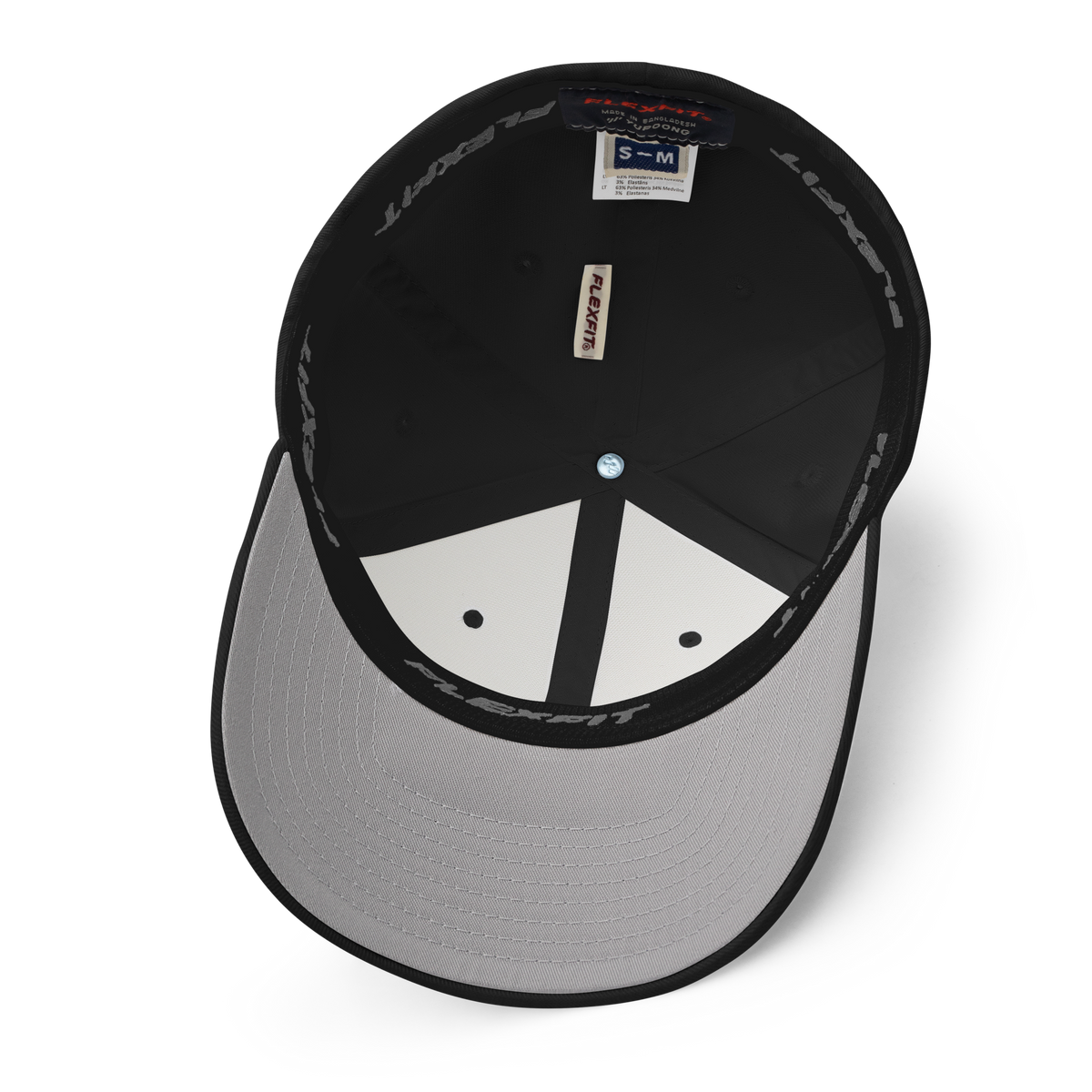
- 63% polyester, 34% cotton, 3% spandex twill
- Structured, 6-panel, mid-profile (with a low-profile embroidery area)
- 6 embroidered eyelets
- Stretch band
- Silver undervisor
- Head circumference: 22”–23⅞” (55.9 cm–60.6 cm)
Size guide
| SIZE (inches) | |
| S/M | 21 ¼-22 ¾ |
| L/XL | 22 ⅜-23 ⅞ |
| SIZE (cm) | |
| S/M | 54-57.8 |
| L/XL | 56.8-60.6 |
Shipping & returns
Shipping & returns
Every item is printed on demand especially for you and shipped worldwide. Full details in our shipping policy.
Size & fit
Size & fit
Most of our tees run true to size. Oversized styles are cut loose on purpose – take your usual size for a relaxed look. European customers: consider ordering a size down.
Share